


Views: 0 Author: Site Editor Publish Time: 2026-08-22 Origin: Site


The term "jade" is heavily unregulated in the global consumer market. This ambiguity creates widespread confusion for shoppers. Many retailers label entirely different green stones as jade. This misleading practice often leads to severely overpriced purchases and buyer remorse.
Purchasing these gemstones without understanding the fundamental mineralogical and market differences carries a high risk. You might pay a premium price for a chemically treated imitation. You could also buy a brittle stone unsuitable for your lifestyle. The stakes are significant when you invest in high-value gemstone pieces.
This article provides a transparent, gemological framework for buyers. We will decode the differences between the two true forms of jade. You will learn how to confidently evaluate, select, and authenticate these stones. By the end, you will understand exactly what drives market value. This knowledge empowers you to make an informed, secure purchase.
Two distinct minerals: "Jade" legally and gemologically refers to two separate silicate minerals: Nephrite and Jadeite.
Visual markers: Jadeite typically displays a glassy luster and vibrant colors, while nephrite offers a waxy, greasy luster with deeper, muted tones.
Durability vs. Hardness: Jadeite is harder (scratch-resistant), but nephrite is tougher (highly resistant to chipping and breaking).
Market valuation: While top-tier Burmese jadeite commands the highest auction prices, authentic Hetian nephrite jade holds profound historical and premium market value.
A foundational misunderstanding plagues the gemstone market today. Many buyers assume they are simply looking at different quality grades of a single stone. This is scientifically incorrect. Legally and gemologically, true jade consists of two entirely distinct mineral families. Understanding the core debate of nephrite vs jadeite requires a brief look at their chemical compositions.
Nephrite represents the ancient stone revered throughout early human history. It is chemically defined as a calcium-magnesium silicate. Its internal structure is fascinating. Nephrite forms through densely interlocking, fibrous crystals. These tightly woven fibers act like microscopic woven ropes.
This unique fibrous structure makes the stone exceptionally tough. It resists shattering upon impact better than almost any other natural gemstone. Miners primarily extract it from deposits in China, specifically the Xinjiang region. Canada supplies significant volumes known as BC Jade. Russia also produces high-quality deposits.
Jadeite entered the mainstream jewelry market much later. It is chemically distinct, classifying as a sodium-aluminum silicate. Its internal structure differs sharply from its historical counterpart. Jadeite consists of granular, interlocking crystals rather than fibrous ones.
These compact granules make the stone denser. It also ranks slightly higher on the hardness scale. Miners source the vast majority of gem-quality jadeite from Myanmar, formerly Burma. Guatemala holds smaller, secondary deposits that yield mostly darker or blue-toned varieties.
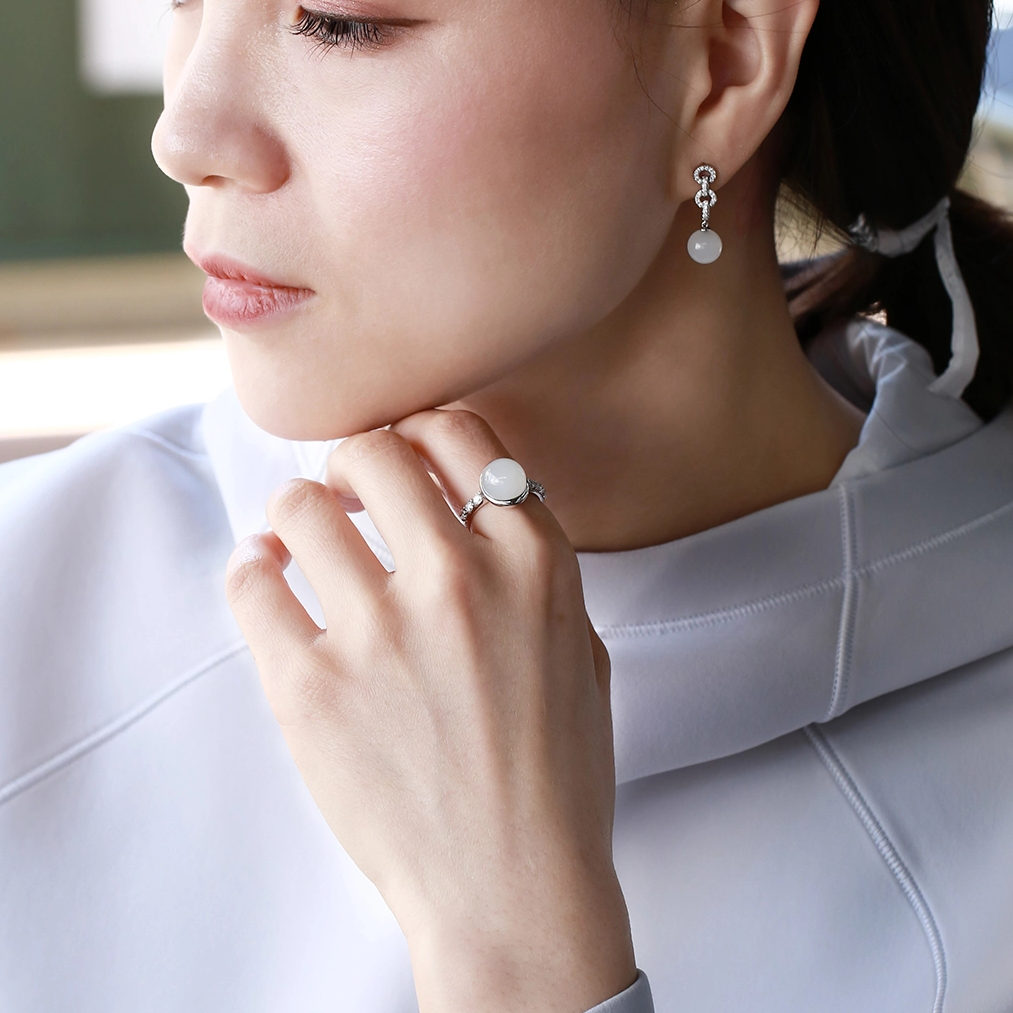
Buyers must know how to physically distinguish between the two minerals. You can often spot key differences when evaluating pieces in person or viewing high-resolution macro photography.
Luster describes how light interacts with the stone's surface. Nephrite exhibits a distinct "greasy" or waxy luster. When highly polished, it looks like a block of smooth, solidified oil. The surface appears creamy. It typically ranges from completely opaque to semi-translucent.
Jadeite reflects light very differently. It exhibits a vitreous or glassy luster. The surface shines sharply, much like polished glass. High-end pieces achieve exceptional translucency. The market often refers to these top-tier translucent stones as "ice" or "glass" types.
The two minerals present noticeably different color palettes.
Nephrite Colors: This mineral is famous for creamy, opaque whites. The market calls the highest grade "Mutton Fat." It also features deep, muted spinach greens, solid blacks, and rich browns.
Jadeite Colors: This mineral boasts a highly vibrant spectrum. It is known for striking emerald tones, famously called "Imperial Green." You will also find bright lavender, pure icy white, vivid red, and golden yellow.
Jewelry buyers frequently confuse hardness with toughness. The Mohs scale measures hardness, which is simply a stone's resistance to scratching. Jadeite ranks between 6.5 and 7 on the Mohs scale. Nephrite ranks slightly lower, between 6 and 6.5. Dust contains quartz, which sits at a 7. Therefore, jadeite resists daily microscopic scratches better.
Toughness measures a stone's resistance to fracturing, chipping, or breaking. Nephrite holds the title for the highest fracture toughness of any natural transparent or translucent gemstone. This extreme toughness makes it the perfect material for intricate carving. It easily survives the impacts of daily wear.
Gemstone Physical Properties Chart
Feature | Nephrite | Jadeite |
|---|---|---|
Chemical Class | Calcium-magnesium silicate | Sodium-aluminum silicate |
Internal Structure | Interlocking fibrous | Interlocking granular |
Luster | Waxy / Greasy | Vitreous / Glassy |
Mohs Hardness | 6.0 - 6.5 | 6.5 - 7.0 |
Fracture Toughness | Exceptionally High | Very High |
Setting realistic budget expectations requires understanding market grading structures. The criteria for pricing these stones differ completely based on their mineral class.
Appraisers use a specific model to price jadeite. Similar to diamonds, they rely on a framework often called the 4Cs.
Color: Saturation and evenness drive the price. "Imperial Green" represents the pinnacle. It commands astronomical premiums.
Transparency: The market refers to this as "water" or "ice." Stones that allow light to pass through clearly are highly coveted.
Texture: This refers to the grain size. Finer, microscopic crystal grains create a more desirable, smoother appearance.
Cut: The stone's proportions and symmetry affect its final appeal and light reflection.
Prices jump exponentially when a piece combines high translucency with vivid color.
Appraisers value nephrite differently. They look for absolute purity of color. High density and a complete lack of internal inclusions dictate the price. The most highly prized variety is Hetian nephrite jade.
The market places a massive premium on authentic river-tumbled stones from the White Jade River in Xinjiang. Nature tumbles these stones for millennia. The river strips away the softer outer layers. This leaves only the densest, most flawless core. These river-seed stones cost exponentially more than mountain-mined material, such as typical Canadian BC Jade.
You must align the mineral characteristics with your intended use. Both stones offer unique advantages depending on the jewelry setting and your lifestyle.
Nephrite excels in durability. It is the ideal choice for high-impact pieces. A daily-wear nephrite necklace will comfortably survive constant movement. Solid bangles carved from this stone resist shattering if you accidentally strike them against a desk.
Choose this stone if you seek classical, understated elegance. It holds profound Chinese cultural significance. It also offers a larger, more substantial piece of jewelry at a highly accessible price point. The only exception involves master-carved, top-tier Hetian river stones, which rival diamonds in price.
Jadeite is the quintessential modern gem. It is ideal for investment-grade rings, delicate earrings, and minimalist settings. These settings allow light to pass through the back of the stone, highlighting its internal ice-like structure.
If you want vibrant, eye-catching color, choose jadeite. It pairs perfectly with diamonds and high-karat gold settings. Buyers seeking high translucency and brilliant saturation will find exactly what they want in fine jade jewelry crafted from this mineral.
The gemstone market is notorious for misdirection. Retailers frequently sell heavily treated stones to unsuspecting tourists and online buyers. You must equip yourself with skeptical evaluation tools.
The industry uses a strict letter-grade system to classify treatments. You must know these before making a purchase.
Type A: This is completely natural, untreated stone. Artisans only use traditional plum juice or beeswax to polish it. This is the only investment-grade choice on the market.
Type B: Manufacturers bleach the stone in acid to remove brown impurities. They then inject it with polymer resins to restore its structural integrity. The polymer inevitably degrades, turns yellow, and cracks over time.
Type C: Manufacturers artificially dye the stone to enhance its color. The dye fades quickly when exposed to sunlight or skin oils.
Sellers often invent names to market cheap simulants. You should immediately walk away if a retailer uses the following terms:
"New Jade" (Typically bowenite or serpentine).
"Korean Jade" (Usually just colored quartz).
"Malaysian Jade" (Often dyed translucent quartz).
"Transvaal Jade" (A massive green grossular garnet).
None of these stones belong to the authentic silicate families discussed above.
Never trust your eye alone. Even seasoned experts struggle to detect modern polymer injections under standard lighting. You must insist on laboratory reports. Independent gemological laboratories, such as the GIA or NGTC, utilize advanced infrared spectroscopy.
These labs will scientifically verify the exact mineral species. They will also confirm the absence of polymer resins and artificial dyes. If you are shopping for authentic Hetian jade or Type A Burmese jadeite, a recognized lab certificate is mandatory. Reputable dealers will always provide this documentation upfront.
Neither mineral is inherently better than the other. They simply serve entirely different aesthetic preferences and budgets. Jadeite offers brilliant, vivid color and glassy transparency that catches the light beautifully. Nephrite offers legendary toughness and a smooth, waxy depth that feels organic and deeply historical.
Before you shop, clearly define your budget and choose your preferred aesthetic. Decide whether you value glassy translucency or waxy durability. Finally, only purchase from transparent retailers. Ensure they clearly identify the specific mineral species and provide independent laboratory certification to back up their claims.
A: Yes. It is one of the two historically and scientifically recognized forms of true jade. For thousands of years, early civilizations exclusively carved it before the other mineral variant entered the broader global market.
A: Generally, high-quality jadeite commands higher auction prices due to its vivid color and high translucency. However, top-tier "mutton fat" Hetian nephrite can easily rival it in cost, largely due to extreme scarcity and historical prestige.
A: A standard steel knife generally will not scratch jadeite due to its higher Mohs rating. However, a steel blade might marginally scratch lower-density nephrite. We strongly advise against scratch tests, as they are destructive and risk permanent damage.
A: Chemically, they belong to the same mineral family. The difference lies in geographic formation and market perception. Canadian stones are typically mountain-mined with consistent quality. Xinjiang stones carry a historical, cultural premium, especially the dense, river-tumbled varieties.


