


Views: 0 Author: Site Editor Publish Time: 2026-08-20 Origin: Site


Entering the nephrite market requires significant capital. It also carries high risks of misrepresentation. Navigating these waters demands more than simply trusting a vendor's claims. Buyers face complex grading systems and rampant geographic arbitrage. How do you distinguish a genuine heirloom from a clever imitation? This guide establishes an objective evaluation framework for Hetian white jade. We base our approach on material science, market realities, and strict strict certification standards. Our goal is simple. We want to equip buyers and collectors with a rigorous shortlisting logic. You will learn how to evaluate authenticity and gauge fair market value. Ultimately, you will gain the knowledge needed to execute secure purchases with confidence.
Structure and "greasiness" (luster) are often more critical indicators of premium Hetian white jade than sheer whiteness.
Color variations directly impact valuation; "mutton fat" represents the apex, while unique dual-tones like sugar white offer accessible alternatives.
Market origin (Xinjiang vs. Russian/Qinghai) heavily influences pricing, requiring verifiable certification (e.g., NGTC, GIA) to mitigate investment risk.
Evaluating structural integrity and processing quality is paramount when selecting high-value formats like a white jade bangle.
Nephrite relies on a microscopic interlocking fibrous structure. This unique mineral composition gives the stone its legendary toughness. When evaluating texture, you must look closely at these fibers. Premium pieces display no visible internal crystalline graining to the naked eye. The structure appears uniform and perfectly tightly knit. High density also yields a heavy, substantial feel in the hand. You can test this by comparing the stone to standard glass or quartzite. Nephrite will always feel notably denser and colder upon initial touch.
Industry experts prioritize luster over sheer color. They evaluate a phenomenon known as "oiliness" or greasiness. This is a visual and tactile effect. The jade appears polished using internal oils. It looks entirely distinct from a glassy, vitreous shine. When you evaluate luster, observe how the stone disperses light. Genuine Hetian white jade produces a soft, warm glow. It absorbs light slightly rather than reflecting it harshly. This optical property stems directly from the tight interlocking fibers diffusing surface light.
Natural stones always carry internal characteristics. You must distinguish acceptable anomalies from critical flaws. Common traits include "water lines" (transparent structural lines) and cotton-like inclusions. These generally affect aesthetics more than structural integrity. However, graphite spots and micro-fissures require careful risk assessment. Micro-fissures severely impact long-term durability. They make the stone prone to cracking upon impact.
Common Inclusions Risk Assessment
Inclusion Type | Visual Appearance | Impact on Value & Durability |
|---|---|---|
Water Lines | Transparent, vein-like streaks | Low risk. Minor aesthetic drop. |
Cotton | White, cloudy patches | Low risk. Reduces visual purity. |
Graphite Spots | Black mineral dots | Low risk structurally, moderate value drop. |
Micro-fissures | Hairline surface or internal cracks | High risk. Compromises structural integrity. |
Mutton fat white serves as the ultimate industry benchmark. Many beginners mistakenly search for a stark, paper-white color. However, true mutton fat exhibits a warm, slightly creamy white hue. It displays maximum grease-like luster. This combination of warmth and extreme oiliness drives the highest market valuations. Pieces achieving this grade represent the highest tier for serious collectors. They appreciate steadily due to extreme material scarcity.
Most available nephrite falls into standard white categories. You must differentiate between pure white, grayish-white, and yellowish-white bases. Pure white commands strong prices but lacks the premium of mutton fat. Grayish undertones typically depress secondary market liquidity. They make the stone look dull under natural light. Conversely, yellowish-white or warm undertones often maintain strong pricing tiers. Collectors appreciate the warmth they bring to carved pendants and bracelets.
Natural oxidation of iron creates a brownish-red or caramel matrix. We call this "sugar" jade. It forms alongside the white nephrite, creating striking dual-tone aesthetics. You will often see this material sourced from Qiemo or Russian mines. When evaluating pieces like a sugar white jade bangle, check for distinct color separation. The boundary between the caramel sugar and the white jade must be sharp. Avoid pieces displaying muddy, gradual transition zones. Crisp contrast significantly elevates the collector value of sugar variations.
Imitations flood the entry-level market. Glass, often marketed as "Liuli," serves as the most common substitute. Glass completely lacks the internal fibrous structure of real nephrite. It frequently contains microscopic gas bubbles. Glass also feels warmer to the touch. Quartzite and marble, sometimes sold as "Afghan Jade," present another trap. They have a lower specific gravity and feel noticeably lighter. These substitutes rely on crystalline structures rather than fibrous ones. They consistently fail hardness testing when compared to genuine nephrite.
Geographic origin dictates massive pricing disparities. Vendors frequently sell Russian, Qinghai (Kunlun), or Korean nephrite at premium Xinjiang prices. This geographic arbitrage poses a major risk. Russian materials often look extremely white but lack true oiliness. Qinghai materials tend to appear overly transparent. Buyers must understand national standards. The GB/T 16552 standard legally defines "Hetian Jade" by its mineral composition (tremolite). It does not define it by geographic origin. Therefore, a certificate stating "Hetian Jade" only proves it is nephrite. It does not guarantee the stone came from Xinjiang. Buyer due diligence remains critical.
Unscrupulous dealers apply artificial enhancements to low-grade materials. They use acid bleaching and polymer impregnation to clear inclusions. This mirrors the "B-jade" treatment seen in jadeite. Additionally, dealers use artificial skin dyeing. They mimic the highly sought-after natural river pebble (Zi Yau) skin. They apply chemical dyes to raw stones and bake them. You can usually spot artificial dyes using magnification. The color concentrates unnaturally in surface cracks and micro-fissures.
Building a valuable Hetian jade collection requires strategic format selection. Different jewelry formats demand varying levels of material perfection.
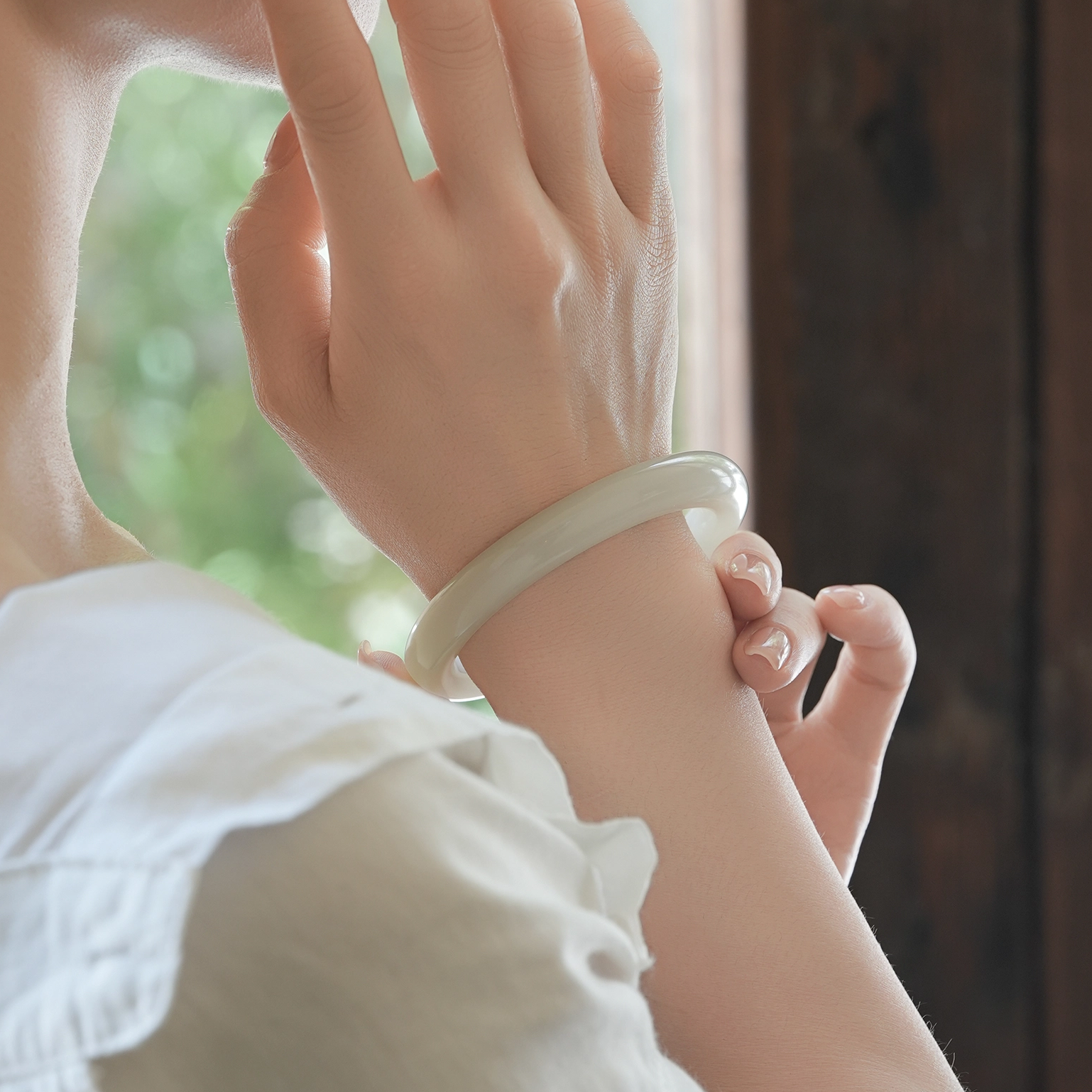
The white jade bangle commands the highest market premium. Producing one requires a massive, flawless block of rough stone. The raw material must boast absolute structural integrity to survive the cutting process. When evaluating this format, examine symmetry and thickness carefully. Inspect the inner and outer polish for perfect smoothness. Finally, perform acoustic resonance testing. Gently tapping a flawless bangle produces a clear, lingering "clink." A dull thud usually indicates hidden internal fractures.
If you want a lower barrier to entry, consider the white jade bracelet. Artisans create beads utilizing smaller off-cuts from larger carving projects. This makes them more accessible. However, evaluation remains strict. Check for bead uniformity across the entire strand. Inspect the drill-hole cleanliness to ensure no chipping occurred during manufacturing. Excellent color matching across the strand signifies superior craftsmanship and sorting.
Master carving significantly alters valuation. Carvers utilize elaborate designs to obscure natural flaws or inclusions. They also use natural "sugar" skins to create stunning cameo effects. When buying carved pieces, assess the artistry alongside material quality. Ensure the carving details feel fluid and purposeful. Poor carving often attempts to hide severe structural issues.
Never rely solely on a vendor's verbal guarantee. Require authoritative lab reports before committing capital. In China, seek National Gemological Training Center (NGTC) certificates. Internationally, rely on the Gemological Institute of America (GIA). These labs verify mineral composition objectively. They also confirm the lack of polymer or dye treatments. Treat uncertified high-value pieces as immediate red flags.
You can perform basic diagnostic tests yourself. Use a 365nm UV light in a dark room. Inspect the piece for resin or glue fluorescence. Natural nephrite will not react, but polymer fillers will glow brightly. Next, use oblique flashlight illumination. Shine a strong light at a sharp angle across the surface. This technique maps internal structures clearly. It helps you identify hidden stress fractures and assess overall fiber density.
Establish strict criteria for trustworthy dealers. Reputable vendors provide transparent sourcing claims. They gladly allow third-party appraisals. They also offer unconditional return windows. If a dealer pressures you or refuses independent testing, walk away. Established merchants understand the necessity of buyer confidence in the fine gemstone market.
Balance your budget allocation based on your core goals. Are you buying for daily wear or long-term collection? Adjust your expectations accordingly. You might opt for a high-quality sugar white piece instead of a heavily flawed pure white piece. Superior structure and luster in a mixed-color stone often outlast and outshine a poor-quality solid white one. Buy the best material quality your budget allows.
Successful acquisition relies on prioritizing structural density and luster over stark whiteness. True value lies in the oiliness and microscopic perfection of the nephrite fibers. Investing in this market requires a skeptical, evidence-backed approach. You must scrutinize origin claims and heavily marketed pricing models. Always rely on established lab certification and objective physical evaluations. Discard vendor narratives that cannot be proven through testing. By applying this disciplined framework, you protect your capital and secure truly exceptional pieces.
A: No. Current gemological standards (like GB/T 16552) define "Hetian Jade" mineralogically as tremolite jade. It does not dictate geographic origin. Therefore, certified pieces can legally originate from Russia, South Korea, or the Qinghai province. True Xinjiang origin commands a massive premium but requires specialized appraisal beyond standard lab certificates.
A: Glass feels warmer and lighter than genuine nephrite. Genuine pieces have a higher specific gravity and feel dense. Under a loupe, glass often reveals spherical gas bubbles. Nephrite, conversely, displays an interlocking, fibrous internal structure. Glass also reflects light harshly, whereas real jade disperses it softly.
A: Historically, pure white pieces dominated valuations. However, market trends are shifting. Distinct, high-contrast sugar white pieces are rapidly appreciating in collector markets. Pieces displaying sharp separation between rich caramel hues and pure white bases hold significant value. Muddy or blended sugar tones remain lower in value.
A: Destructive testing is strongly discouraged for finished jewelry. While nephrite is harder than steel and resists scratching, attempting this can damage polishes or expose micro-fissures. Instead, use non-destructive alternatives. Rely on specific gravity tests, oblique lighting, 365nm UV examination, and independent lab certification to verify authenticity.


