


Views: 0 Author: Site Editor Publish Time: 2026-08-25 Origin: Site


Purchasing a high-value piece of jewelry always carries high stakes. The modern gemstone market bursts with misleading terminology and opaque pricing. This makes your final purchasing decision incredibly daunting. Buyers often evaluate Hetian jade using the wrong standards. They apply criteria meant for jadeite. They look for high transparency and vivid green colors. This critical error leads to poor purchasing decisions. Buyers end up overpaying for heavily treated stones instead of natural quality. You need a different standard. This guide provides a gemological-grade, evidence-based framework for evaluating Hetian nephrite. It removes the guesswork from your buying journey. You will learn how to assess texture, structure, and authenticity. Using these tools, you can confidently invest in a piece. Your chosen bangle will retain its inherent value and structural integrity over time.
Hetian jade is judged primarily on its dense texture and "greasy" luster, not glassy transparency.
The 7 critical evaluation factors are texture, color, structure, shape, craftsmanship, material origin, and certification.
Balancing a budget requires strategic compromises; prioritizing texture over pure whiteness often yields a better long-term investment.
Always require an independent gemological certificate to verify you are buying an untreated, authentic piece.
You must first clarify the exact material you are evaluating. Hetian jade is scientifically known as Nephrite. It consists of calcium magnesium silicate. It possesses a tightly interlocked fibrous crystalline structure. This makes it distinct from Jadeite. Jadeite is a sodium aluminum silicate. It features a more granular crystal composition. They share the cultural title of "jade," but they act like entirely different stones.
You must shift your evaluation mindset. The market values jadeite for its glass-like translucency and vivid colors. It sparkles and shines. Conversely, Hetian jade operates on different aesthetic principles. Experts prize it for an opaque-to-translucent density. It resembles pristine mutton fat. It emits a subtle, oily sheen rather than a bright sparkle. You evaluate it by its tactile warmth and dense presence.
You face a harsh market reality today. Unethical sellers frequently use jadeite evaluation metrics to manipulate buyers. They polish inferior nephrite to look artificially glassy. They try to sell overpriced, heavily treated stones. Some even pass off cheap quartz imitations as premium jade. If you apply jadeite standards to nephrite, you will fall into these traps.
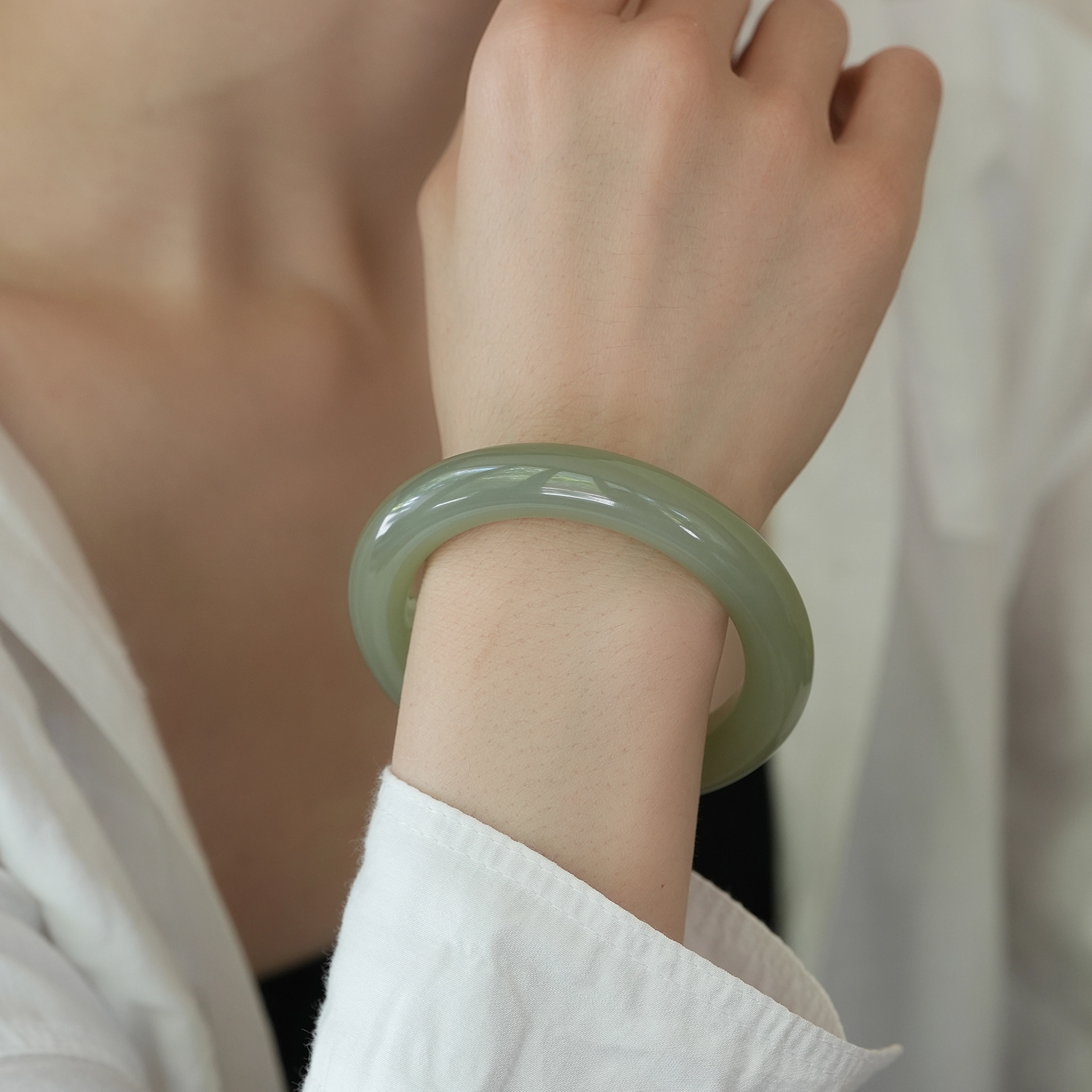
When you decide to choose Hetian jade bangle quality, you must rely on objective metrics. You cannot rely purely on emotion. A standard jade bangle requires careful inspection across seven distinct categories.
Texture dictates the ultimate value of Hetian jade. You should look for a smooth, exceptionally dense internal structure. It should feel "oily" or "waxy" to the touch. It should never feel like cold, clear glass. The underlying evaluation rule is simple. The finer the microscopic crystalline structure, the higher the overall quality. A premium piece absorbs light softly. It looks remarkably like polished animal fat.
Color remains an important secondary metric. The standard colors range from pure white to green, yellow, and black. Experts highlight pure "Mutton Fat White" as the absolute premium tier. It commands the highest market prices.
However, you have excellent nuanced options. You might consider a light greenish white jade bangle. These pieces often feature an incredibly dense, excellent structure. They sit at a much more affordable price point. Alternatively, you can evaluate a sugar white jade bangle. These unique bangles feature natural, oxidized iron intrusions. The iron creates a beautiful caramel or sugar-like color gradient. It adds immense character without compromising structural density.
You must learn to differentiate between natural inclusions and fatal flaws. Natural inclusions often look like tiny cotton spots or faint water lines. They represent the natural geological formation of the stone. Fatal flaws are different. They usually manifest as tactile surface cracks.
Risk mitigation requires a keen eye. A bangle containing internal "cotton" remains completely natural. It poses no structural threat. Conversely, a bangle containing a crack is a major structural liability. If your fingernail catches on a surface line, do not buy it. It will eventually break upon impact.
Style variations directly impact comfort and durability. The classic Round Bangle offers timeless symmetry. People also call it the Peace Bangle. The D-Shape Bangle features a flat inner surface. People refer to it as the Safe and Sound style. You might also encounter intricately Carved or Princess styles. The inner curvature determines daily wearability. A flat inner surface sits flush against your skin. A rounded inner surface rolls smoothly over your wrist bone. Both provide different impact resistance profiles.
You must conduct a strict execution check. Evaluate the symmetry of the cut. Check the uniform thickness around the entire band. Assess the quality of the final polish. Master carvers spend hours perfecting the surface. A superior polish organically enhances the natural greasy luster. It entirely eliminates the need for artificial waxes or chemical coatings.
Material origin creates a massive value hierarchy in the market. You will encounter two main types. River Seed Jade comes from ancient riverbeds. The industry calls it Zi Liao. Water and abrasive sand weathered these stones for millennia. This process created an incredibly dense, premium material. Mountain Jade comes directly from rock veins. The industry calls it Shan Liao. Miners extract it using heavy machinery. It is much more common. It generally has a looser crystal structure compared to Seed Jade.
Establish a rigid trust standard. Never buy a high-value piece without a verifiable certificate. You must demand paperwork from a recognized gemological laboratory. The NGTC (National Gemological Training Centre) serves as a primary authority. A valid certificate confirms the exact mineral composition. It proves you are buying untreated nephrite.
Every buyer faces the Iron Triangle of Jade Buying. You cannot have flawless texture, pure whiteness, and a low price simultaneously. You must pick two. Adding pieces to your Hetian jade collection requires realistic financial planning.
Table: Strategic Trade-offs in Jade Buying
Buyer Goal | Prioritized Features | Necessary Compromise |
|---|---|---|
Investment Focus | Seed Jade (Zi Liao), Dense Texture | Accept a slight greenish tint or natural sugar coloration. |
Aesthetic Focus | Pure Whiteness, Clean Look | Accept Mountain Jade (Shan Liao) or minor internal "cotton". |
Strict Budget Focus | Low Price, Wearability | Accept smaller sizes, noticeable inclusions, or common colors. |
If you focus on investment, prioritize Seed Jade. It offers excellent texture and density. You might have to accept a slight greenish tint to stay within budget. This remains a highly strategic trade-off. If pure white is your aesthetic goal, accept Mountain Jade. It may contain minor internal "cotton" inclusions, but it provides the visual impact you desire.
Consider the scalability of your collection over time. Treat your first purchase as a foundational piece. Learn to appreciate its unique characteristics. Stop chasing an unattainable, flawless "perfect" bangle. Perfection usually indicates a synthetic fake.
You must confront the measurement reality before browsing. A beautiful bangle holds no value if it cannot pass over your knuckles. You need an exact method for measuring your wrist and knuckle width. Use a flexible measuring tape. Compress your knuckles tightly together. Measure the widest part of your hand. Factor in hand flexibility. Remember that hands often swell later in the day. Always measure your hand in the afternoon or evening.
Use a strict shortlisting logic to protect your time and money:
Determine exact size: This instantly narrows the available market by 80%. You only browse what actually fits.
Set a hard budget limit: Define your absolute maximum spend. Stick to it without exception.
Filter by certified sellers only: Immediately discard any vendor lacking independent gemological reports.
Select based on trade-offs: Apply the texture-to-color compromise that best fits your established budget.
The market thrives on deception. You must actively look for common scams. Fraudulent sellers use sophisticated techniques to fool novice buyers.
Watch out for these prevalent deceptive materials:
Glass Imitations: They look flawless but contain tiny internal air bubbles. They feel unnaturally lightweight.
Quartz (White Marble): Sellers market this as "Xinjiang white jade." It lacks the oily luster of true nephrite. It feels dry and chalky.
AF Materials: Artificially Forged synthetics mimic the exact density of real stone. They require lab testing to identify.
Acid and polymer treatments represent a massive threat. Scammers take low-quality, heavily flawed nephrite. They submerge it in industrial acid baths. This bleaches out all natural impurities. The industry calls this B-grade treatment. The acid severely compromises the structural integrity. They then inject epoxy resins and polymers into the weakened stone. The industry calls this C-grade treatment. The polymers fake a flawless, dense structure. Over time, these polymers yellow and degrade. The bangle will eventually turn brittle and ugly.
Always apply the "Too Good to Be True" rule. An authentic jade bracelet boasting flawless Mutton Fat whiteness at a bargain price does not exist. It is mathematically guaranteed to be a simulant. It might be heavily treated. Protect yourself by walking away from unbelievable deals.
Choosing Hetian jade remains an exercise in valuing subtle beauty. You must prioritize dense texture, structural integrity, and verified authenticity. You must ignore the flashy, glass-like transparency associated with jadeite. Real nephrite offers a warm, oily luster. It feels substantial and grounding.
Your next steps are clear and actionable. First, measure your hand accurately using the compressed knuckle method. Second, request independent lab certificates for any shortlisted bangles. Third, verify those certificates online. Finally, prioritize trusted vendors. Ensure they offer highly transparent, no-questions-asked return policies. This systematic approach guarantees a successful and secure purchase.
A: Yes, you can generally wear it in the shower. Water does not harm dense nephrite. In fact, wearing it daily exposes the stone to your natural skin oils. These oils enhance its signature greasy luster over time. However, avoid exposing it to harsh industrial chemicals, strong acid-based cleaners, or extreme sudden temperature changes.
A: Hetian nephrite often exhibits mild pleochroism. The internal fibrous structure interacts differently with varying light wavelengths. Natural sunlight highlights the rich, warm caramel tones of the iron intrusions. Artificial fluorescent lighting often flattens these colors. It makes the stone appear colder or slightly grayish. Always evaluate your jade under natural daylight.
A: No. A certificate only guarantees authenticity and material type. It confirms you are buying untreated natural nephrite rather than glass or quartz. It does not dictate high market value, aesthetic beauty, or superior craftsmanship. You must independently evaluate the texture, polish, and structural integrity using the metrics outlined above.


